

Why Choose Ease Commerce for Returns Management?
Complete Return Lifecycle
Visibility
Returns often get tracked across support, warehouse, and finance separately. Ease Commerce connects the full product return management journey from request, AWB tracking, QC, and restocking to credit notes and reconciliation in one system.
Automated Return & RTO Processing
As return volumes grow, manual coordination causes delays and duplicate refunds. Ease Commerce automates CIR approvals, courier updates, RTO tracking, and status transitions so returns move through clear operational stages.
B2B & Credit Note
Control
For B2B sellers, returns must align with invoices and credit notes. Our Returns Management Platform records credit note numbers, invoice values, and adjustment status in one place, so finance teams reconcile faster and reduce disputes..
Warehouse-Level Accountability
Returns only close once the stock is verified. Each inward entry captures product name, quantity, condition, warehouse location, and staff responsible, so no returned item goes unaccounted.
Marketplace-Specific Compliance
Every marketplace handles returns differently. Ease Commerce supports platform-aware return flows so sellers manage claims, updates, and reversals while staying compliant with marketplace rules.
Actionable Return Insights
Returns reveal operational problems. Our analytics highlight high RTO regions, repeated SKU issues, and portal-wise return trends so teams can reduce return rates and improve product listings.
Explore Our Core Returns Management Solution Capabilities

Structured Return Intake & Workflow Control

Portal-Wise Return Sync
All returns from Amazon, Flipkart, Shopify, Nykaa, and other marketplaces and your website sync into one dashboard. No separate logins. No manual tracking sheets.
CIR & RTO Lifecycle Management
Track Customer Initiated Returns and Return-To-Origin orders from raised → in transit → received → adjusted → closed.
AWB-Level Return Tracking
Search and filter returns using AWB number, order ID, portal, invoice number, or date range for faster resolution.
Status-Based Return Segregation
Open vs Closed return visibility ensures nothing remains unprocessed or financially unadjusted.
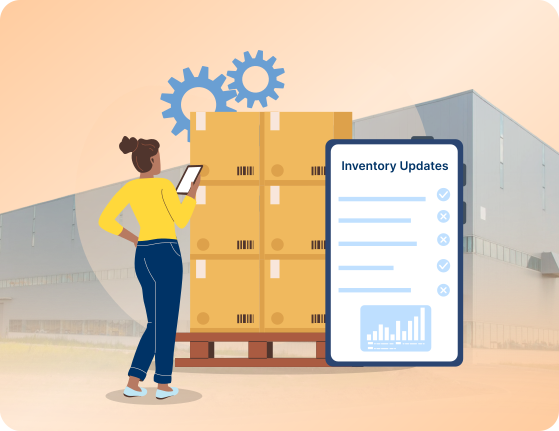
Warehouse-Level Return Verification & Stock Recovery
Return Inward Logging With Accountability
Every return inward captures product name, quantity received, condition, warehouse location, and staff responsible.
Condition-Based Inventory Updates
Returned goods are tagged as saleable, damaged, or hold stock before being re-added to live inventory.
Batch, Expiry & QC Validation
Expiry-sensitive categories are verified before reintegration, reducing dead inventory risk.
Shrinkage & Discrepancy Reporting
Mismatch between expected and received quantity is documented for claims and audit control.

Financial Reconciliation & Credit Note Management
B2B Return & Credit Note Tracking
Credit note numbers, invoice values, customer details, and adjustment status are recorded in one structured view.
Marketplace Claim & SAFE-T Tracking
Monitor reimbursement claims, submission dates, approval status, and deductions to reduce revenue leakage.
Invoice-Level Adjustment Visibility
Finance teams can reconcile return-adjusted invoice amounts without cross-checking multiple reports.
Downloadable Audit Reports
Export return and credit data for GST filing, compliance, and financial audits.

Data-Driven Return Insights & Control
SKU-Level Return Rate Analysis
Identify products with high return frequency and recurring issue patterns to improve product quality and listing accuracy.
RTO Region & Courier Performance Tracking
Pinpoint high-RTO zones and underperforming logistics partners to optimize delivery operations and reduce return rates.
Return Reason Categorization
Track structured reason codes to improve listing accuracy, packaging decisions, and reduce repeat returns.
Return Processing Time Monitoring
Measure turnaround time from return initiation to final adjustment to improve operational efficiency and speed.
Performance Metrics With Impact
Faster Return Processing Time
Structured return workflows reduce delays between return requests, pickup, inward QC, and financial adjustment. Teams stop chasing status updates and start clearing return backlogs faster, especially during peak sales cycles.
Return-to-Inventory Accuracy
Barcode-based inward logging and condition tagging ensure returned SKUs are correctly verified before restocking. This minimizes ghost inventory, prevents double refunds, and protects resale value.
Lower Revenue Leakage From Returns
With credit note tracking, RTO visibility, and marketplace claim monitoring, brands reduce missed reimbursements and incorrect financial deductions. Finance teams reconcile faster without cross-checking multiple systems.
Frequently Asked Questions
Return management software helps e-commerce brands track, process, and reconcile customer returns, RTOs, and refunds from a single system. It manages return requests, courier pickups, warehouse QC, inventory updates, and financial adjustments through a structured workflow, reducing operational gaps and revenue leakage.
Yes. SKU-level analytics highlight products with high return frequency, recurring defect codes, or abnormal RTO rates. This helps brands improve packaging, product descriptions, supplier quality, and listing accuracy before returns impact margins.
Key return KPIs include return rate by SKU, RTO percentage, return turnaround time (TAT), refund processing time, damage rate, and reverse logistics cost per order. Tracking these metrics helps reduce avoidable returns and improve recovery speed.
Reverse logistics is the process of moving returned products from customers back to the warehouse. It includes return approval, pickup scheduling, AWB tracking, quality inspection, restocking, refund processing, and claim reconciliation. A structured system reduces delays and financial loss.
RTO tracking ensures returned shipments are monitored by AWB, courier partner, and warehouse location. This prevents lost inventory, duplicate refunds, and delayed restocking while improving cash flow visibility.
Multi-warehouse routing directs returns to the nearest or most suitable facility. This reduces reverse shipping cost, shortens turnaround time, and speeds up inventory reintegration.
Automated courier mapping selects the most cost-effective pickup partner based on pincode, SLA, weight, and return type. This optimizes reverse shipping costs while maintaining service reliability.
Integration with ERP and warehouse systems ensures inventory adjustments, credit notes, and refund entries update automatically during return processing. This reduces accounting errors, prevents duplicate refunds, and improves audit readiness.
Yes. A structured return system can manage marketplace returns (Amazon, Flipkart, Shopify) along with B2B returns, including credit note tracking and invoice reconciliation, within a single dashboard.
Returned items are scanned and tagged as saleable, damaged, refurbishable, or rejected during inward processing. Inventory updates instantly, preventing ghost stock and incorrect availability.
Marketplace claim workflows track submissions, required documentation, approval status, and settlement impact. This ensures reimbursement opportunities are not missed and reduces financial leakage.
By analyzing return reasons, RTO patterns, courier performance, and SKU-level defect trends, brands can fix listing errors, improve packaging quality, optimize size charts, and refine supplier standards.
Automated workflows significantly reduce return processing time by streamlining approvals, courier mapping, inward logging, inventory updates, and refund triggers without manual coordination.
Yes. High-volume brands benefit from structured workflows that prevent backlog buildup, reduce operational confusion, and protect margins during peak sales cycles.