
Ease Commerce Becomes India’s Official Amazon MCF Partner: Faster Fulfillment, Zero Chaos

By: Maitri Bhardwaj

Nov 27, 2025
Table of Contents
Featured Posts
- Ease Commerce Becomes India’s Official Amazon MCF Partner: Faster Fulfillment, Zero Chaos
- How the Right Customer Support Solution Boosts FCR
- What Is Returns Management for Multi-Channel Sellers
- Choosing the Right Task Management Software for Sellers
- How to Tell If Your E-Commerce Business Is Ready for a Warehouse Management System
Most Indian brands, rather than being short on demand, are just short on dependable fulfillment. Orders don’t come in neatly. They hit from Amazon, your online store, and other connected sales channels, as well as your own WhatsApp/catalog flows, often within the same hour. Operations teams then juggle four different SLAs, three label formats, two stock ledgers, and one angry customer who wants it tomorrow.
You feel this crunch most during the festive surge. GMV spikes, but warehouses and last-mile capacity don’t magically double. This year and last, multiple industry trackers flagged the same pattern: marketplaces forecast record sales while capacity lags, creating split shipments, missed SLAs, and overtime bills that eat margin.
Why does it keep happening? Fragmentation. Inventory gets duplicated across channels. OMS and WMS don’t always agree on what’s “available.” Reverse flows (returns, RTO) pile up just when you need clean forward movement. Even large third-party carriers admit the network is consolidating and repricing, which makes predictable planning harder for brands stuck on manual orchestration.
Zoom out, and the macro picture backs up your day-to-day pain. Redseer’s deep dive on India’s B2C e-commerce logistics calls out a structurally fragmented network that still needs tighter orchestration and technology to hit reliability at scale. It also shows just how complex multi-stage e-logistics is. First mile, mid-mile sortation, last mile, and then the entire reverse loop; each handoff is a new failure point if systems aren’t speaking to each other.
Costs reflect that complexity. Fresh government-backed analysis from DPIIT/NCAER pegs India’s logistics cost near 8% of GDP, still meaningfully higher than best-in-class systems once you factor in the hidden costs of e-commerce reversals, re-attempts, and idle inventory. When your network isn’t unified, those costs show up as late orders, forced partials, and dead stock, exactly the things customers punish and marketplaces downrank.
Let’s ground it with a floor-level day:
- 10:07 AM: A COD order lands on your website, stock shows “2” in the ecommerce app, but the FC has “1.” The pick ticket waits for a manual override.
- 12:41 PM: An order from one of your sales channels splits because the nearest node has the SKU but not the right size; the next node has the size but no correct packaging template.
- 3:55 PM: A marketplace order is ready, but the booked delivery lane gets capacity-capped; rerouting changes the promise date by a day and triggers a penalty.
- 6:18 PM: Your returns bin crosses the threshold; reconciliation slips to “tomorrow,” which means the same SKU isn’t sellable tonight even though it’s physically back.
Multiply that by 500 orders, and you get the chaos you’ve been firefighting.
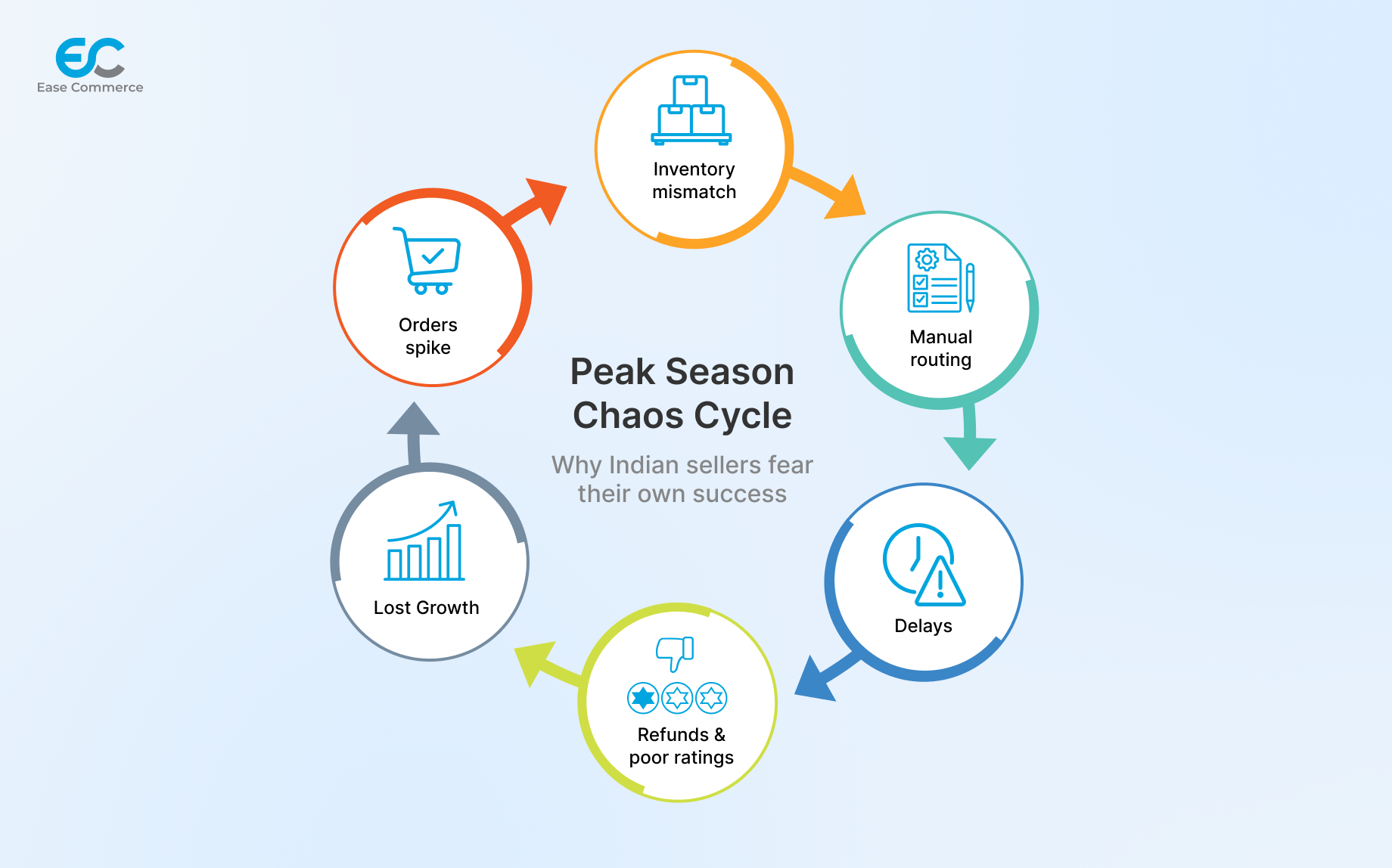
There are bright spots. Much research data show return initiation rates improving with better tech and process discipline (customer-initiated returns down from ~10% to ~7.8%), proof that integrated workflows pay off. But to turn that into speed and predictability, you need fulfillment muscle plus a brain that routes, syncs, and reconciles across channels in real time.
That’s exactly where Amazon’s Multi-Channel Fulfillment (MCF) and Ease Commerce’s unified automation layer come together to make fulfillment predictable, fast, and transparent.
Ease Commerce integrates Amazon’s fulfillment, inventory, and reconciliation systems seamlessly.
See how Amazon integration works inside Ease Commerce →
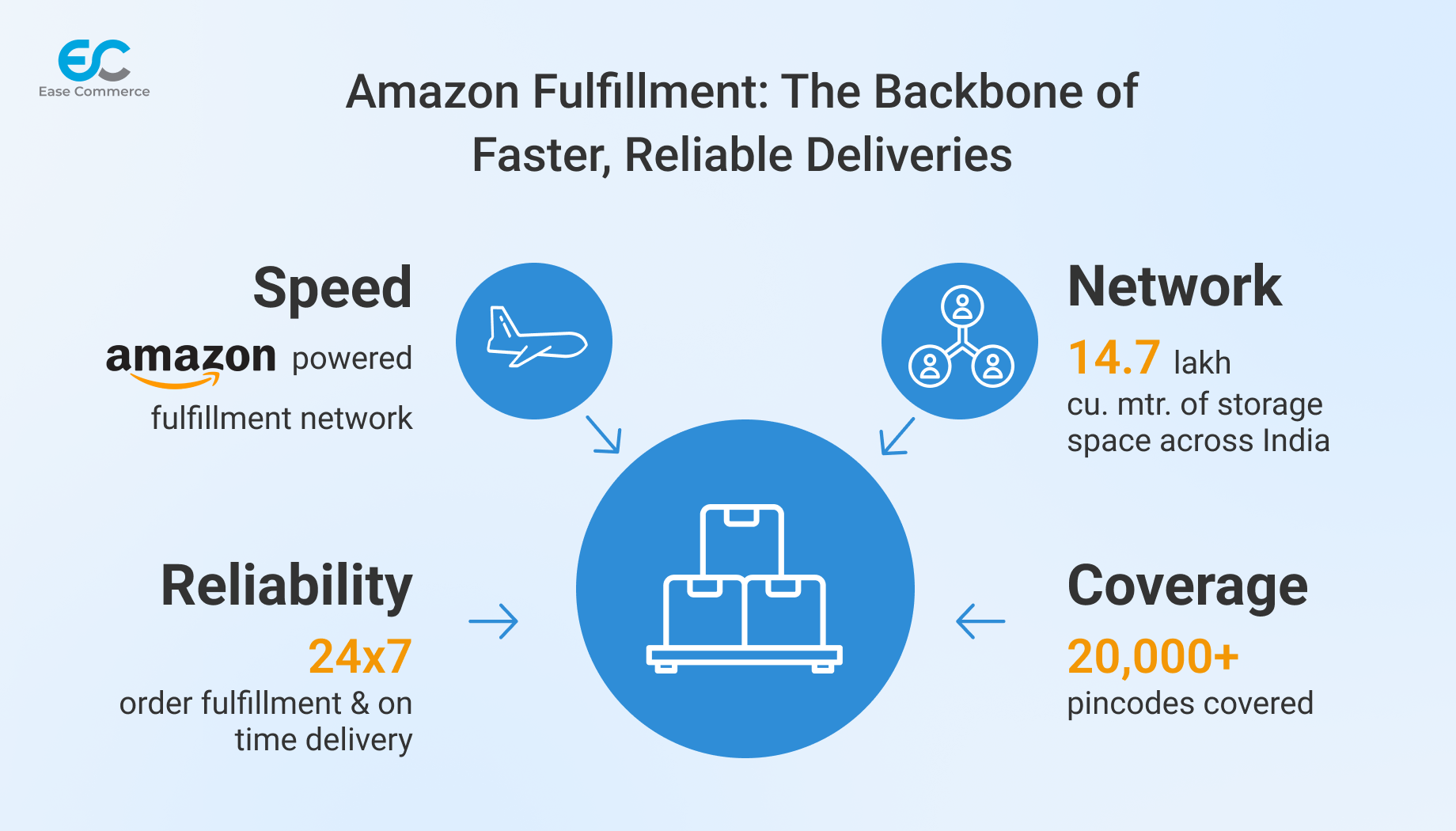
Amazon brings nationwide reach (covering essentially all serviceable pin codes with Prime-grade SLAs), while Ease Commerce plugs into every sales channel and keeps inventory, orders, labels, and reversals in one control tower so your team ships from the fastest, nearest node while keeping shipping costs low, without touching a spreadsheet.
What MCF really means for your business
Imagine you sell on Amazon, your own Shopify store, and also via social media. Usually, that means three different fulfillment paths: one warehouse for your store, one for Amazon, one for direct sales (or tying in a 3PL). You spend time and money managing stock across channels, juggling shipping vendors, fulfilling returns, matching SKUs, and hoping nothing falls through the cracks.
MCF changes the fingerprint of that mess. What it gives you:
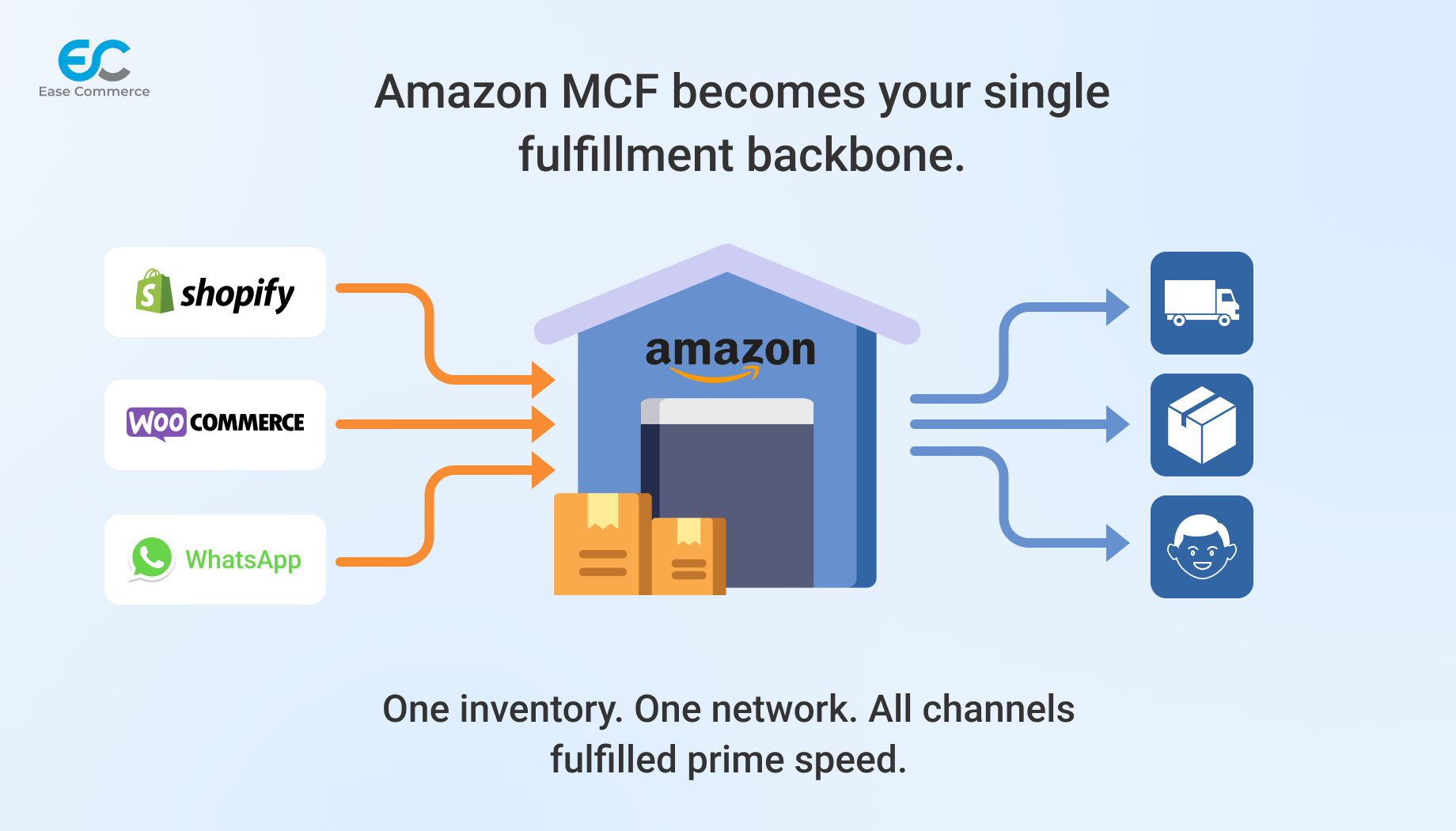
- You send your goods to Amazon’s fulfillment network (their warehouses, their pick-pack-ship system). As soon as inventory is in, it doesn’t matter which channel the order comes from. Whether it’s your website checkout or a sale from any connected channel, Amazon MCF picks, packs, and ships it just like any Prime order.
- You no longer need separate logistics partners for each channel or a warehouse just for your D2C site. The same Amazon FC network handles everything, reducing duplication and risk of stock error.
- Delivery expectations go up. With Amazon’s network, you tap into their infrastructure: large scale, dense geography, extensive last-mile reach. You can confidently offer fast shipping services, and even expedited shipping options in key regions, without building that network yourself. One Indian case study says orders that used to take up to 11 days were fulfilled in 7 days once MCF was used.
- Trust factors matter. When a buyer sees “2-day delivery” or “Shipped by Amazon’s network”, conversion rises. MCF provides the underlying infrastructure so your brand gets a trust boost via fulfillment reliability.
You consolidate inventory, one pool serving multiple channels. Less risk of double-selling, less hassle with channel-by-channel stock management.
What Amazon MCF & Ease Commerce Partnership brings for Multi-channel Sellers
Here’s what this partnership really brings to the table:
1. Channels still differ —
Your Shopify store, your offline POS, your Instagram Live shop, your Amazon listing, all have different order formats, different SKU logic, different shipping/returns rules. Amazon MCF handles fulfillment, but doesn’t inherently handle the upstream orchestration: syncing all those orders, filtering, mapping SKUs, deciding what goes to MCF vs what you fulfill in-house.
2. Data flows matter —
For each order you need: inventory availability, channel metadata (COD vs prepaid, SKU combos, bundle logic), returns updates, shipping updates. Without integration, you either do manual work or build custom APIs. That’s where Ease Commerce becomes the “brain”. It integrates your channels, applies your rules (e.g., route COD orders to your own warehouse, let prepaid go to MCF), and ensures the right orders hit Amazon and the right ones stay internal.
3. Routing logic is key —
MCF gives you the network, but you decide which orders should go where. For example, high-value orders, local city purchases with your own faster warehouse, small, remote PIN codes may be better sent via MCF due to Amazon’s reach. Ease Commerce allows you to define those rules and enforce them automatically—so you’re not just outsourcing fulfillment but also optimizing fulfillment intelligently.
4. Where Sellers Stay in Control —
Every brand has its own comfort zone. Some prefer to confirm orders before sending them to MCF; others trust auto-routing. Ease Commerce allows both. Sellers can plug confirmation into their chatbots for prepaid orders, or verify COD orders manually and push them to Amazon once cleared. Partial COD is also managed intelligently, half paid online, half on delivery, and the system keeps track without creating parallel ledgers.
Routing rules are set once and then forgotten. COD orders can be reserved for Tier-1 cities via MCF, while prepaid flows anywhere Amazon delivers. If Amazon’s node rejects an order or times out, Ease Commerce cancels the request and pushes it back to your warehouse instantly.
Every move is tagged in Shopify, so your team always knows which path an order took. You can even define regional restrictions, say, all North-East orders via MCF, or all Delhi NCR via your local hub, and the system will follow your map, not guesswork.
This is the difference between automation that works for you and automation you have to babysit.

5. Operational visibility and control —
MCF gives the service, but as a seller, you still need visibility into order status, tracking, returns, reconciliation, which channel the order came from, what fulfillment path was used. Ease Commerce centralizes that into dashboards, flags exceptions, gives you real-time metrics. Without that layer, you might be fulfilling well but still lack control or insight.
6. Brand and process continuity —
If you sell multi-channel, you don’t want to look like you’re just “Amazon shipping your store”. You want your packaging logic, your SKUs, your bundles, your GST filings, your regional routing. Ease Commerce ensures the MCF layer plugs into your brand ecosystem rather than overriding it.
Why This Is a Breakthrough for Indian Sellers
Fulfillment doesn’t collapse during peak season because of one giant problem. It collapses because fifty small operational misses all hit at once. Oversells. One wrong bin location. A COD verification call that took too long. A courier door that shut three minutes early. Every Indian seller who has lived through Diwali knows the truth: scale exposes chaos.
This partnership fixes those hidden cracks before they turn into refunds and support calls.
Inventory finally becomes one truth. The moment a product sells on your website, Amazon, or any connected sales channel, it instantly reflects across Amazon’s fulfillment centers as well. That means you stop promising units you don’t have. That means fewer apologies. That means repeat orders instead of reactive refunds.
Payment mode doesn’t complicate operations anymore. COD and prepaid slide into the same workflow, and rules decide the route, not people under pressure. Example logic that sellers already use inside Ease Commerce:
- Prepaid → always to Amazon fulfillment for fast delivery
- COD → only metro Tier-1s via Amazon; everything else stays internal
- High-ticket → auto-callback before routing
It’s not limited to a simple warehouse decision but a business strategy executed automatically.
Here’s where the impact hits measurable KPIs.Internal Ease Commerce pilots show up to 40% faster turnaround times when orders are routed automatically to the nearest available fulfillment node. Not more manpower. Not more warehouses. Just fewer stalls in motion and noticeably lower effective shipping costs per order.
Finance breathes easier with GST-ready invoices, labels, manifests, and payment types all align behind the scenes. No “missing paperwork” will be delaying dispatch. No last-day-of-month scramble for IRNs.
And the wins appear where a spreadsheet can’t show them:
- A Mumbai fashion brand reduced partial orders to zero, even during peak, by eliminating split inventory.
- A Delhi beauty label saw prepaid checkout rise sharply once faster delivery commitments appeared on their product pages.
- A Bengaluru hardware seller noticed WISMO tickets dropped because tracking updated quickly and consistently.
These sound like small victories until they add up to fewer support costs, lower return probability, and faster repeat business.
Because the reality is: India’s demand scales in jumps, not curves. Nobody gets 10% growth per month. They get 10x in three days during Navratri or the New Year. When that wave hits, your system can either ride it… or drown under it.
Amazon brings the reach and delivery consistency.Ease Commerce brings the routing intelligence, exception handling, and reconciliation muscle.
Together, fulfillment stops being a risk… and turns into a quiet, compounding competitive edge.
The Invisible Wins That Keep You Profitable
Operational chaos usually shows up in places dashboards don’t measure. COD reconciliation is one of them. Ease Commerce directly integrates with Amazon’s settlement reports, so finance doesn’t chase courier logs or spreadsheets. A payment mismatch that used to take three days now takes three clicks.
Multi-GST sellers finally stop worrying about location-based compliance. Whether you’re invoicing from Delhi, Bengaluru, or Jaipur, Ease Commerce applies the right GST registration automatically and generates reports ready for filing. No manual cross-checking.
Inventory clarity has always been the hidden pain point for multi-channel sellers. The platform separates FBA stock from Seller Flex, so only real FBA stock reflects on Shopify. That single change reduces “order not available” tickets to almost zero.
Real-time tracking makes WISMO messages drop fast. Teams see where every order is FBA or warehouse in one view. A live shipment dashboard shows fulfillment speed, delay reasons, and courier trends in real time. No one’s guessing where the bottleneck is.
Most e-commerce companies talk about scaling by adding people. This stack scales by removing human intervention. Route optimization platforms report up to 20% savings on last-mile delivery costs when real-time conditions are factored into routing, instead of static routes. Ease Commerce builds that efficiency into every order.
Bottom Line
Scaling shouldn’t mean losing control. With Ease Commerce as India’s Official Amazon MCF Partner, your fulfillment finally becomes predictable, even when demand spikes without warning.
- One dashboard.
- One inventory truth.
- Nationwide, Prime-like fast shipping services at a predictable cost.
Your best sales day can now be your easiest fulfillment day. Request your own personalized demo today, and let’s make that effortless fulfillment your new normal.
FAQs on Amazon MCF Partner
1. What is Amazon Multi-Channel Fulfillment (MCF), and how is it different from FBA?
Amazon MCF lets you use Amazon’s fulfillment network to deliver orders from any channel, not just Amazon. So, whether an order comes from your website or any connected sales channel, Amazon picks, packs, and ships it with the same reliability as Prime. The difference is that FBA serves Amazon customers, while MCF serves your entire business.
2. How does Ease Commerce integrate with Amazon MCF?
Ease Commerce connects all your sales channels, including Amazon and your D2C platforms, into a single control tower. It automatically routes orders to Amazon MCF when it’s faster or cheaper and keeps others in your internal warehouse when that makes more sense.The integration is API-based and doesn’t require custom middleware or manual order uploads.
3. Can I control which orders go to Amazon MCF and which stay in my warehouse?
Yes. Ease Commerce gives you rule-based routing control — you can set logic like:
- Prepaid orders → Amazon MCF
- COD orders → Internal warehouse
- Tier-1 city deliveries → Amazon
High-value items → Manual confirmation first. Once these rules are live, the system enforces them automatically. No daily toggling or approvals.
4. Does Ease Commerce support COD and partial-COD workflows with MCF?
Absolutely. Ease Commerce can handle full, partial, and hybrid COD transactions. If part of the payment is collected online and the rest on delivery, the system automatically reconciles both without double entries or mismatched ledgers, a crucial advantage for Indian D2C sellers.
5. How does this partnership help during peak sale seasons like Diwali or Prime Day Sale?
During spikes, most sellers struggle with split shipments, returns pile-ups, and stock mismatches. Ease Commerce + MCF eliminates this chaos by:
- Consolidating all inventory into one unified pool
- Auto-routing orders to the nearest Amazon FC
Rolling back delayed MCF orders to your warehouse automatically. This keeps SLAs intact and refund rates low, even when order volumes multiply overnight.
6. What kind of visibility and reports will I get through Ease Commerce?
You get a live operational dashboard showing:
- Real-time tracking of all orders (MCF + internal)
- Shipment delays and exceptions
- COD settlement and GST compliance reports
Channel-level reconciliation data: No CSV downloads or toggling between systems.
7. Will my brand identity remain intact if I ship through Amazon’s network?
Yes. Ease Commerce ensures your packaging, invoices, GST numbers, and brand experience remain consistent. Amazon fulfills the logistics; Ease Commerce preserves your brand logic and workflows.
8. What are the measurable results from this integration?
Ease Commerce’s internal pilots show:
- 40% faster turnaround times
- Zero split orders even during high demand
- 99%+ on-time delivery accuracy with Amazon’s network
- Significant drops in WISMO (Where Is My Order) tickets
9. How long does it take to set up the Amazon MCF integration through Ease Commerce?
Most brands go live within 3–5 business days, depending on how many channels they’re connecting. Our onboarding team helps map SKUs, test order flows, and sync live inventory before full rollout, no downtime required.
10. Who is the Amazon MCF + Ease Commerce partnership best suited for?
This setup is ideal for:
- Multi-channel sellers managing both D2C and marketplace sales
- Growing D2C brands expanding nationwide
- Regional warehouses looking to scale without new infrastructure
Finance or ops heads tired of reconciling invoices and COD mismatches